

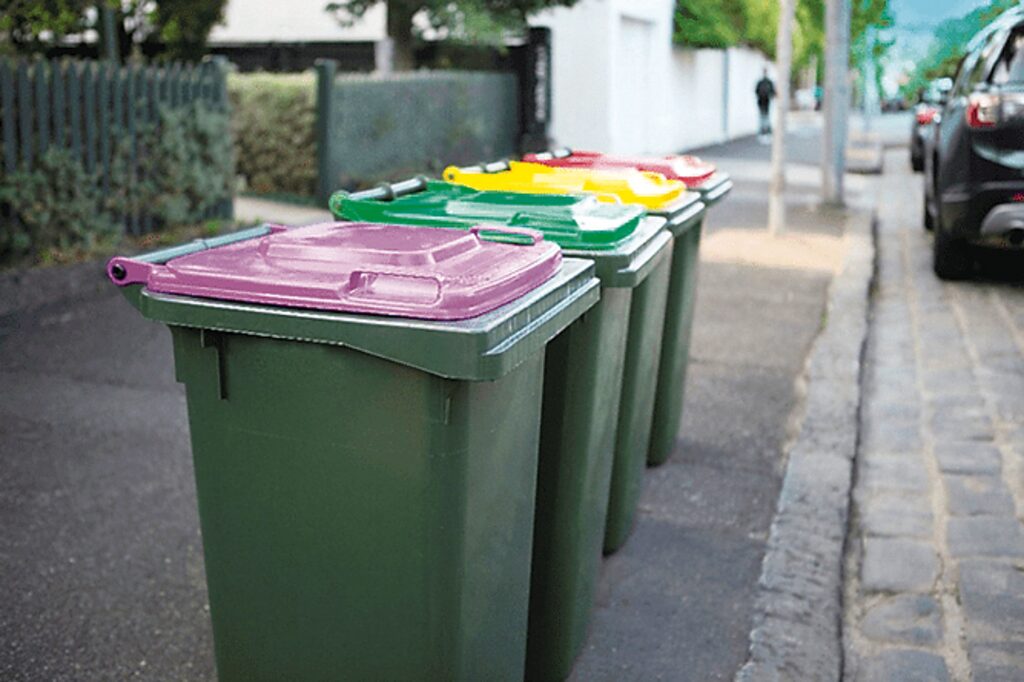
Wellington Shire Council has renewed its opposition to the state government’s proposed mandatory glass recycling bin, calling for greater flexibility to ensure waste services remain affordable and practical for regional communities.
At its meeting on Tuesday, council resolved to write to the Environment Minister again, formally opposing the mandatory implementation of a separate kerbside glass recycling service through a fourth purple-lidded bin.
Council previously resolved in July 2025 to request the government reconsider the mandatory glass recycling requirement. To date, council has not received a response.
Deputy mayor Liz Foat, who moved the motion, said council’s position reflected growing concern about the cost and practicality of introducing a fourth household bin across regional Victoria.
“Many households are already experiencing rising living costs, and we’re concerned another mandatory bin will place further financial pressure on residents without demonstrating a clear community benefit,” Cr Foat said.
Cr Foat said the state government’s existing Container Deposit Scheme (CDS) was already providing an effective pathway for recovering significant amounts of glass, reducing the need for an additional kerbside collection service.
“The proposed glass kerbside recycling service was developed before the introduction of the CDS,” she said.
“Now it’s in full swing recovering large volumes of glass, we believe the government should carefully consider whether a mandatory fourth bin is necessary before imposing additional costs on residents.”
The motion also highlighted the operational challenges associated with introducing another bin across Victoria’s third largest municipality geographically, and the need for waste management that meets local circumstances.
“One-size-fits-all solutions do not always work for regional communities; councils need flexibility to design waste services that respond to local needs, infrastructure and financial capacity while still meeting environmental goals,” Cr Foat said.
Cr Foat said Wellington was not alone in raising concerns, with several neighbouring and regional councils having passed similar resolutions seeking greater flexibility around the proposed service.
“Councils right across Victoria are raising similar concerns because they are hearing the same message from their communities about affordability and practicality,” she added.
Cr Foat maintained while council supported the implementation of a food organics and green organics (FOGO) bin due to its significant financial and environmental benefits, as well as strong community demand, the case for a separate glass bin was less clear.
“Council supports weekly FOGO collection because it provides obvious benefits for the environment and ratepayers. By recycling food and garden organics, we can reduce long-term costs for ratepayers by significantly decreasing the volume of waste going to landfill, while ensuring food waste is collected frequently and hygienically,” she said.
“However, in terms of a separate glass bin, our residents are already successfully recycling a lot of glass through the Container Deposit Scheme. Council’s concern is whether the additional cost of a fourth kerbside bin can be justified when alternative recovery pathways already exist.
“We believe we should have the flexibility to determine the most effective and affordable way to achieve recycling outcomes for our community.”
Council will now write to the state government seeking reconsideration of the mandatory glass recycling service requirement and advocating for greater flexibility in how councils achieve recycling outcomes.
Wellington is part of a growing list of councils across Victoria who are calling on the government to delay the roll-out of a fourth kerbside bin for glass. Under the Circular Economy (Waste Reduction and Recycling) Act 2021, Victorian councils are required to transition to a standardised four-stream waste and recycling system by 2027, including separate bins for food and garden organics, glass recycling, mixed recycling and general waste.
The government’s stated aim is to improve recycling outcomes by reducing contamination from shattered glass in the commingled mixed recycling stream.